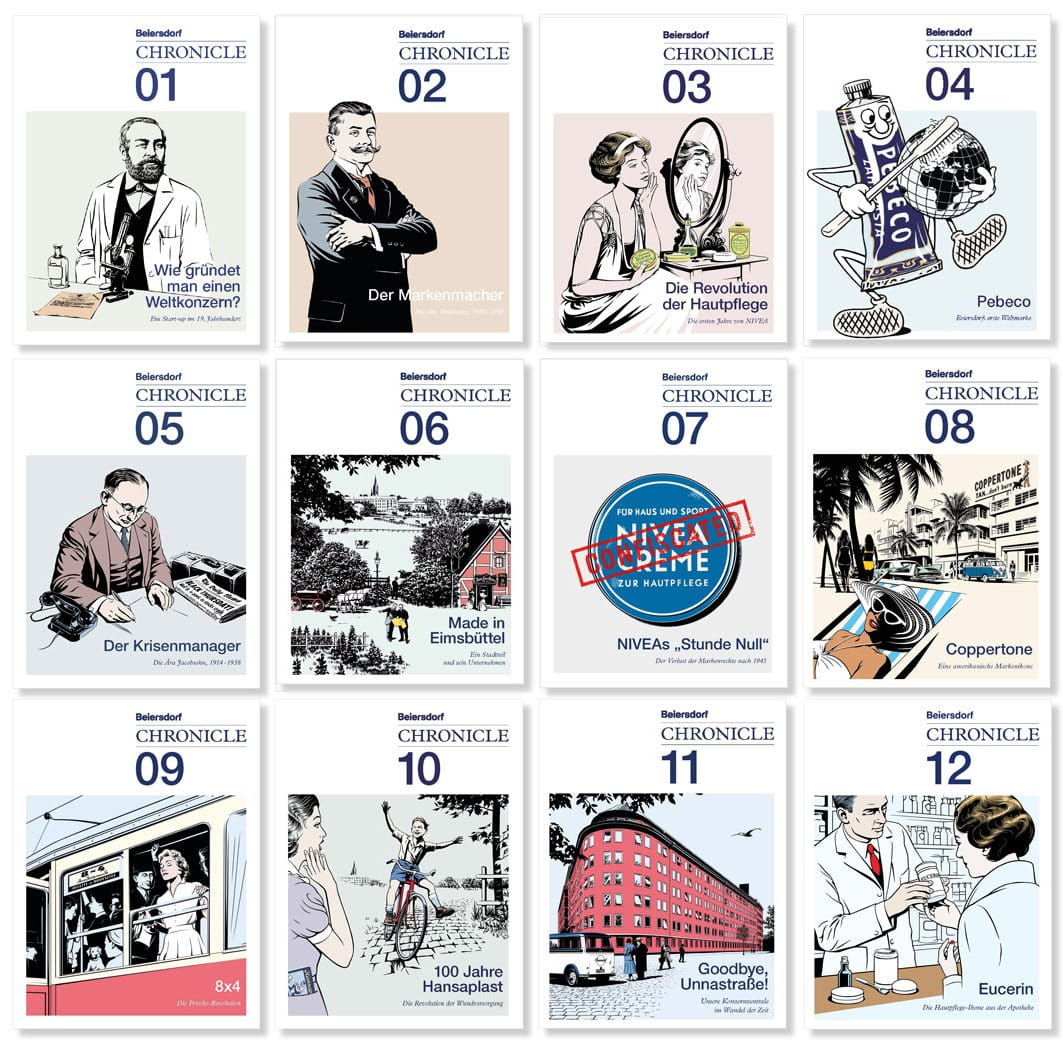
Beiersdorf Personalities

Curiosity and persistence are fundamental to bringing groundbreaking innovations to the market. The people behind these innovations are crucial in achieving our milestones. Learn more about the individuals who have contributed significantly to the success of Beiersdorf AG.

Paul C. Beiersdorf

(1836 – 1896)

In 1880, Paul Beiersdorf settles down in Hamburg as a pharmacist. In collaboration with the dermatologist Paul Gerson Unna, he develops innovative plasters and receives his first patent in 1882 for the “gutta-percha plaster gauze”. This marks the birth of Beiersdorf. In 1890, the founder sells the laboratory to Oscar Troplowitz.

  • Paul C. Beiersdorf was born in Neuruppin in the Brandenburg Marches. In the fall of 1880, the pharmacist settled in Hamburg at the age of 44. In the years prior, he had served as the Technical Director of a galvanizing plant in Moscow, then as co-owner of an apparatus manufacturing company in Berlin, afterwards as the owner of a pharmacy in Bärwalde and later in Silesian Grünberg. With the purchase of the pharmacy near St. Michael’s church in Hamburg, he fulfilled his dream of being independent in a large city. The area around the harbor was already densely populated, and Beiersdorf hoped for a profitable business.

    Working closely with dermatologist Prof. Dr. Paul Gerson Unna, he established the plaster business, obtaining his first patent in 1882 for “guttapercha plaster gauze”. The date of the patent specification also marks the founding date of the company that still bears his name today. 

Prof. Paul Gerson Unna

(1850 – 1929)

He is probably the most famous freelancer in Beiersdorf’s history: Paul Gerson Unna. The most important dermatologist of his time worked closely with both Paul Beiersdorf and Oscar Troplowitz.

  • The most famous freelancer in company history and the most well-known and important dermatologist of his time was born in 1850 in Hamburg. After graduating from high school, Unna studied medicine at the Universities of Heidelberg, Leipzig and Strasbourg. In 1881, he opened a private dermatological clinic on Dammtorstraße in Hamburg. At this time, he first met Paul C. Beiersdorf, in close collaboration with whom he developed a process for the manufacture of coated plasters – the very product on which our company was founded in 1882.

    Unna also got on well with Beiersdorf’s successor, Dr. Oscar Troplowitz, and they continued the successful collaboration. Upon his recommendation, Troplowitz hired the chemist Dr. Isaac Lifschütz who invented the emulsifier Eucerit, the basic substance and the key to the uniqueness of NIVEA Creme. With Unna’s prestigious name, products like NIVEA Soap, released in 1906, were sold as well. In 1907, the Hamburg Senate gave him the title of Professor, in 1908, he became head physician at the Hamburg-Eppendorf Hospital. The year the University of Hamburg was founded, 1919, he became an honorary professor and received the first chair in dermatology. All his life, Unna understood the importance of combining clinical and experimental research symbiotically. He died in 1929 in his hometown at the age of 79 and left behind an extensive body of research for posterity.

Dr. Isaac Lifschütz

(1852 – 1938)

His professional life revolved around sheep’s wool: in the 1880s, chemist Isaac Lifschütz was not interested in its warming effect, but in the wool wax it contains. He isolated the emulsifier Eucerit from it and applies for a patent for the process. Eucerit is the most important ingredient in modern Eucerin and NIVEA creams.

  • In 1852, Dr. Isaac Lifschütz was born in what today is the Belarusian city of Pinsk. At the age of 18, he first studied in Switzerland and then at the University of Freiburg im Breisgau, where he received his doctorate in chemistry in 1884. In the years that followed, Lifschütz dedicated himself to among other things the study of lanolin, extracted from sheep’s wool, a composition of which he made public in 1896. Two years later, he had a breakthrough: Lifschütz isolated the emulsifier Eucerit from the raw material. In 1900, he registered this manufacturing process with the patent office. The dermatologist Prof. Dr. Paul Gerson Unna recognized the importance of Eucerit for dermatology and made the salve basis Eucerin extracted out of it a central theme of his dermatology periodical.

    Despite all this scientific recognition, the big success of Lifschütz’s discovery only came when he arrived at Beiersdorf as a chemist in 1911. So that production of Eucerin could begin quickly, Beiersdorf purchased a large number of machines and manufacture processing rights from his former employer. Eucerin became the basis of the skin cream NIVEA and thereby, essential for the economic rise of Beiersdorf. Lifschütz retired in 1931 and died in Hamburg in 1938.

Dr. Oscar Troplowitz

(1863 – 1918)

From a small laboratory to an international corporation: our success story is largely thanks to Oscar Troplowitz. In 1892, the pharmacist and entrepreneur built the first factory and developed global brands such as NIVEA, Eucerin, and Hansaplast. He also set milestones by introducing company social benefits such as paid vacation and a pension fund.

  • Troplowitz was one of the major entrepreneurial personalities of his time. After training as a pharmacist with his uncle, the subsequent Court Counselor Gustav Mankiewicz, he graduated with a degree in pharmacy in 1886 from the University of Breslau. In 1890, he acquired Paul C. Beiersdorf’s laboratory in Altona and transformed it into a company. He immediately mechanized production and, in 1892 set up his own factory on what was then a 1,200m² plot of land in Lokstedter Weg (known today as Unnastrasse). The company’s headquarters can still be found there to this day. As a customer- and market-oriented entrepreneur who thought and acted internationally from the start, he took care to ensure the further development of his products on a sound scientific footing. He continued the cooperation with Prof. Paul Gerson Unna that had been started by Paul C. Beiersdorf and employed at his recommendation the chemist Dr. Isaac Lifschütz, who invented the emulsifier Eucerit – the basic ingredient of NIVEA Creme – among other things.

    Troplowitz also set a milestone in the Company’s history with the many company benefits he provided his employees. For example, he was one of the first employers in Hamburg to reduce the working week to 48 hours without cutting pay and gave blue-collar and white-collar workers vacation pay. In addition, he set up a welfare fund for employees in financial hardship and the Troma (the Beiersdorf pension and widows’ and orphans’ fund), which was named after him and his brother-in-law, and co-shareholder Dr. Otto Hanns Mankiewicz and which still exists in a modified form today.

    Also worthy of mention are his many public activities and his support for charitable foundations, or his famous art collection in the villa on the Agnesstrasse; following the death of his wife in 1920, this was bequeathed to the Hamburger Kunsthalle art gallery.

    His most significant achievement, however, was to create the brands such as Leukoplast, Labello, and NIVEA, which are so famous today. Troplowitz was convinced that branded goods offering reliable quality and real, substantial benefits to the consumer would be a successful concept for the future. This work laid the foundations for the company’s strategy today.

Gertrud Troplowitz

(1869 – 1920)

With no business experience, she makes the right decision: After her husband Oscar dies unexpectedly in 1918 and her brother Otto Hanns Mankiewicz six months later, Gertrud Troplowitz becomes the heiress at the head of the company.

  • Gertrud Troplowitz, born Mankiewicz, was born on July 23, 1869, in Posen. In 1891, she married Dr. Oscar Troplowitz, who held a doctorate in pharmacy. Her fortune enabled her to acquire the patent for the manufacture of coated plasters and Paul C. Beiersdorf's laboratory. Together with her husband, she thus laid the foundation for further development of the company. This was followed by investments in new machinery and production facilities.

    Gertrud Troplowitz was also an art enthusiast and patron, often working alongside her husband. Their home at Agnesstraße 1 in Hamburg-Winterhude featured works by artists such as Max Liebermann and Pierre-Auguste Renoir.

    Following the death of her husband in April 1918 and that of her brother Otto Hanns Mankiewicz a few months later, she took over the management of P. Beiersdorf & Co. as single owner. She received support from her bank, her authorized signatories, and Dr. Carl Melchior. Under her leadership, the company was converted into a limited liability company in 1920, and P. Beiersdorf & Co. GmbH was founded.

    Gertrud Troplowitz died unexpectedly of a heart attack on August 20, 1920, at the age of 51. After her death, the Hamburger Kunsthalle received seventeen paintings from her estate as a donation. Her social commitment is still recognized today, and she is considered one of the most influential figures in the early history of Beiersdorf.

Dr. Otto Hanns Mankiewicz

(1871 – 1918)

Above all, family is something to rely on: Otto Hanns Mankiewicz initially pursued a career in law. He advised his brother-in-law, Oscar Troplowitz, on legal matters. In 1906, Mankiewicz becomes a partner in Beiersdorf & Co. A founding member of the Markenverband, he is a driving force behind our branded-goods philosophy.

  • Dr. Otto Hanns Mankiewicz was born on July 1, 1871, in Posen. As the younger brother of Gertrud Troplowitz, he is part of Beiersdorf’s history. After graduating from high school in Posen, he began studying law. Following academic stays in Giessen and Leipzig, he completed his studies in Göttingen in November 1895 with a doctorate.
    Dr. Otto Hanns Mankiewicz joined the company Beiersdorf & Co. in 1903. As in-house counsel, he initially spent some time in New York before returning to the company’s Hamburg office to take on a consultative role. In 1906, he became a partner in the firm. As part of this process, Beiersdorf & Co. was converted into a general partnership that same year.

    In addition to his work as a lawyer, he devoted himself to other interests. He was a founding member of the Trademark Association, which has existed from 1903 to the present day. Throughout his life, he contributed his expertise in trademark law and the development of strong brands to the company. He was also active as a patron of the arts. For instance, he supported Bohemians and other artists, served as secretary on the board of the Lessing Society, and became a member of the Hamburg Art Association in 1912. It is well known that the kindness of Dr. Otto Hanns Mankiewicz and his brother-in-law Dr. Oscar Troplowitz soon became widely known in Hamburg’s artistic circles.

    Dr. Oscar Troplowitz died in April 1918. His friend, brother-in-law, and business partner, Dr. Otto Hanns Mankiewicz, died just seven months later, on December 2, 1918.

Dr. Carl Melchior

(1871 – 1933)

He provides stability in uncertain times: Carl Melchior is a lawyer, banker, diplomat and partner in a banking house. In 1920, together with Gertrud Troplowitz, he initiates the founding of P. Beiersdorf & Co. GmbH. This led to our present-day stock corporation in 1922.

  • Born in Hamburg in 1871, Dr. Carl Melchior was a German lawyer, banker, diplomat, and shareholder of the bank M.M. Warburg & Co. He was also one of the most important fiscal policy makers in German history. Head of the German finance delegation at the negotiations for the Treaty of Versailles in 1919, he was also of great significance to Beiersdorf.

    In his capacity as a shareholder of M.M. Warburg & Co., he was the direct trusted contact of Beiersdorf cofounder Dr. Oscar Troplowitz regarding financial matters until Troplowitz’s passing in 1918, after which he advised Troplowitz’s wife Gertrud. Following Gertrud’s sudden death in 1920, Melchior assisted with the founding of P. Beiersdorf & Co. GmbH, which became a joint-stock company in 1922. Because the shares formerly owned by Gertrud Troplowitz, which had been transferred to Warburg by will, carried 25 times the voting rights, the family's heirs were unable to secure a majority. This resulted in a stable course for the company during the uncertain times of the Weimar Republic in spite of the uncertainty of the heirs’ situation, which was marked by self-interest. Melchior himself was appointed Chair of the Supervisory Board upon the corporation Beiersdorf AG being founded in 1922. In the years preceding his death, Melchior’s dedication played a significant part in the company’s stability and international success. Carl Melchior died in Hamburg in 1933 at the age of 62.  

Dr. Willy Jacobsohn

(1884 – 1963)

Willy Jacobsohn worked at Beiersdorf during a very difficult period in European history. At the end of World War I, he took over as head of the international division.  In 1922, he became the company’s first Chairman of the Executive Board.

  • Born in Stolp (Pomerania), Willy Jacobsohn first trained as a pharmacist and subsequently studied natural sciences and chemistry at the universities of Munich and Berlin. After obtaining his doctorate in 1909, he worked in a small pharmaceutical factory before moving to Beiersdorf in 1914. At the end of the war, he became one of four managing directors in charge of the laboratory and the international division. In 1922 – by which time Beiersdorf had become a stock corporation – he was appointed chairman of the board of directors. Under his leadership, following the end of World War I, the company not only expanded its operations in Hamburg but, above all, built up its international business.

    In 1933 he resigned – along with the other Jewish members of the Executive Board – and took over responsibility for the company’s international business from the Netherlands, from where he then emigrated via London to Los Angeles in the United States in 1938.

Carl Claussen

(1878 – 1954)

He leads our company through the National Socialist era and initiates the reconstruction after the end of the Second World War: Carl Claussen takes over as Chairman of the Executive Board in 1933 – after the politically motivated resignation of CEO Willy Jacobsohn. He hands over this position to his son, Georg Wilhelm Claussen, in 1954.

  • Carl Claussen (born in Bremerhaven and died in Hamburg) was a member of the company’s Supervisory Board from 1920, the date Beiersdorf GmbH was founded. Initially employed in his father’s forwarding agency until 1927/28, he took over as Chairman of the Executive Board in 1933 after Dr. Willy Jacobsohn resigned for political reasons. He managed the company throughout the National Socialist era until 1954. Claussen had married Martha Pulvermacher, a niece of Dr. Oscar Troplowitz, in 1908. He started rebuilding the company following the end of the war, a task that his son Georg Wilhelm Claussen continued.

Juan Gregorio Clausen

(1890  – 1977)

As a former frigate captain, he drew inspiration from the sea and the clouds. In 1925, he created our blue-and-white NIVEA design.

  • Born in 1890, the former frigate captain in the Imperial German Navy started at our company in 1920. As a newcomer to the industry, he quickly took on responsibilities in the advertising department. When Clausen took over, the business was experiencing a certain dead calm. Furthermore, NIVEA’s image in the green and yellow art nouveau style was showing its age. Clausen brought the brand back on course. He revitalized NIVEA with a blue and white design, probably preventing its disappearance from the market. According to one legend, the former captain was inspired by ocean and clouds when he created a design icon in 1925 by changing the colors of the cream tin. The new cursive design of the cream font in 1959 can also be traced back to him. But Clausen brought success to other Beiersdorf brands as well. The former Head of Advertising created the catchy name 8X4. This name comes from the active ingredient B32, which was one of the ingredients in the first 8X4 deodorizing products. For 40 years the creative newcomer shaped the advertising of Beiersdorf before retiring in 1960. In 1977, Clausen died at 87.

Georg W. Claussen

(1912 – 2013)

What a lifetime achievement: Despite his father Carl's reservations, Georg Claussen, great-nephew of Oscar Troplowitz, joins the company in 1938. He served as Chairman of the Executive Board from 1957 to 1979, then Chairman of the Supervisory Board until 1987.

  • Georg W. Claussen, son of Carl Claussen and his wife Martha (née Pulvermacher), was born in 1912, the grandnephew of founder Dr. Oscar Troplowitz in Hamburg.

    After several international trips and a commercial apprenticeship, he joined the company in 1938 – despite the doubts of his father. As of 1952, he was acting member of the board of Beiersdorf AG. Two years later, he became a full member and on June 28, 1954, he was appointed Speaker of the Board. From 1957 to 1979, he was CEO of Beiersdorf AG, after his retirement in 1979 until 1987, he was Chairman of the Supervisory Board. From 1989, he was an Honorary Chairman.

    Beyond Beiersdorf, Claussen was actively involved in numerous institutions. In 1982, on the occasion of Beiersdorf AG’s 100th anniversary, he founded what is now the Claussen-Simon Foundation, which primarily supports young people with scientific and technical talents. His social commitment was recognized with, among other honors, the Grand Cross of the Order of Merit of the Federal Republic of Germany, the Richard Merton Medal of Honor from the Stifterverband, and the Gold Constitution Medal of the Hanseatic City of Hamburg.

Dr. Hellmut Kruse

(1926 – 2018)

Entrepreneurial spirit, passion, and vision: Hellmut Kruse shaped our company for more than 30 years. In 1963, two years after joining Beiersdorf, the PhD graduate from Hamburg took over responsibility for international business as a member of the Executive Board.

  • Born in Hamburg in 1926, he studied literary history and philosophy at the University of Hamburg and Fribourg, Switzerland, where in 1948, he received his doctoral degree. Afterwards, he worked first as an export merchant and individually liable member of Wiechers & Helm, Hamburg, the company of his father. Hans E. B. Kruse (†1968) was Chairman of Supervisory Board of Beiersdorf AG 1933-1968. Hellmut Kruse became a member in 1961 first as an acting Board Member before he became a regular member in 1963. Positioned as an acting Chairman since 1975, from 1979 to 1989 he was Chairman of the Board. Afterwards from 1989 to 1994, he belonged to the Supervisory Board of Beiersdorf AG.

Hans-Otto Wöbcke

(1930 – 2017)

He is regarded as the architect of the NIVEA umbrella brand: From 1973 onward, Hans-Otto Wöbcke is responsible for the Cosmed division, following the introduction of the divisional organization.

  • Born in Offenau in 1930, he first trained as a commercial clerk at a brokerage house in Hamburg. After holding management positions in the Unilever Group and at Edeka headquarters, he joined Beiersdorf in 1971. He initially held the position of Marketing and Sales Manager for personal care products and plasters in Germany, before taking over management of the cosmed division in 1973 after the introduction of the divisional structure. An alternate member of the Executive Board since 1974, he was appointed a full member a year later. In 1988, he was appointed Deputy Chairman of the Executive Board, and from 1989 to 1994, he was Chairman of the Executive Board. He was a member of the Supervisory Board of Beiersdorf AG from 1994 until 2004.

Dr. Rolf Kunisch

(1941 – 2018)

He strengthens Beiersdorf’s international focus. Dr. Rolf Kunisch successfully positions NIVEA as a global brand and plays a key role in securing our corporate identity.

  • Rolf Kunisch was born in Arolsen in 1941. He studied economics and engineering at Darmstadt Technical University from 1960 until 1966, and then spent two years as a research assistant at University of Cologne. After leaving academia for the world of business, becoming a product manager at Procter & Gamble for products including Lenor and Dash. Following a period in the United States from 1973 to 1975, he became Marketing Manager and in 1979, General Manager. He came to Beiersdorf in June 1991, and was appointed to the Executive Board with responsibility for the former cosmed division. He was Chairman of the Executive Board from 1994 to 2005. From 2005-2011, he was a member of the Supervisory Board of Beiersdorf AG.

Thomas-B. Quaas

(Born in 1952)

Thomas Quaas has had an impressive career at Beiersdorf. He started as a trainee and later held positions as sales director, marketing director, and head of a business division. In 1999, he was appointed to the Executive Board.

  • Born in Glauchau, Saxony in 1952, Thomas-B. Quaas settled in West Germany with his family before the Wall was built. He spent the majority of his youth in Frankfurt on the Main, where he also studied business. At the end of his studies, he started his career as a trainee at Beiersdorf. After his positions as Sales Director, Marketing Director and Division Manager, he was called to serve on the Board in 1999. By 2003, he was responsible for the Medical category on the Board, from 2003 to 2005 for Supply Chain. In 2005, he took over as chairman. Under his leadership Supply Chain processes were sustainably modernized. In 2008, he brought Beiersdorf into the DAX 30. After he retired from the Board in 2012, Thomas-B. Quaas switched to the Supervisory Board of Beiersdorf AG, which he was a member of until 2014.

Stefan F. Heidenreich

(Born in 1962)

On to new horizons: After holding executive positions at Reckitt Benckiser, Bertelsmann, and the Hero Group, successful sailor Stefan Heidenreich will become CEO of Beiersdorf in 2012.

  • Born in 1962 in Bremerhaven, Stefan F. Heidenreich studied business administration in Kiel. After graduating, the passionate sailor began his career as a Brand Manager at Procter & Gamble. After several leadership positions at Reckitt Benckiser, Bertelsmann and the Hero Group he was the CEO of Hero from 2004 to 2011. In 2012, Heidenreich became CEO of Beiersdorf. In the same year, he started the company strategy Blue Agenda which focused on NIVEA. With this compass and the increasing efficiency in operations under Heidenreich, the company’s value doubled under his leadership. On December 31st, 2018 Stefan F. Heidenreich retired from the Board.

Stefan De Loecker

(Born in 1967)

A well-traveled manager: after completing his studies, Stefan De Loecker held international management positions at the Nestlé and Tesco Group. In 2012, he joined Beiersdorf as Senior Vice President Near East.

  • Stefan De Loecker is a Belgian national and was born in Siegen (Germany) in 1967. After completing studies in Applied Economic Sciences at the University of Antwerp in Belgium, he began his career at the Nestlé Group, where he soon assumed international management responsibilities. In 2011, he joined Tesco plc in the UK as COO and later assumed the position of CEO of Tesco Slovakia. He joined Beiersdorf AG in 2012, initially as Senior Vice President Near East. In 2014, he was appointed to the Executive Board. He was named Deputy Chairman of the Executive Board on July 1, 2018 and became CEO on January 1, 2019. With his comprehensive strategy C.A.R.E.+, he laid the foundation for the further internationalization and digitalization of the company. On July 30, 2021 Stefan De Loecker retired from the Board.