

In the fall of 1880, pharmacist Paul C. Beiersdorf moved to Hamburg at the age of 44 and purchased a pharmacy near St. Michael’s Church, fulfilling his dream of running his own business. Drawing on his experience as a technical director, entrepreneur, and pharmacist, he established a laboratory and began offering his scientific expertise to local doctors, laying the foundation for what would become the Beiersdorf company.
Working in close cooperation with Prof. Paul Gerson Unna, a leading dermatologist of the time, he developed a process to manufacture medical plasters, and registered his first patent for it.
The date of the patent specification – March 28, 1882 – is considered to be the foundation date of the company. Beiersdorf sold the pharmacy a year later, and moved the laboratory to Altona, which is now part of the city of Hamburg.
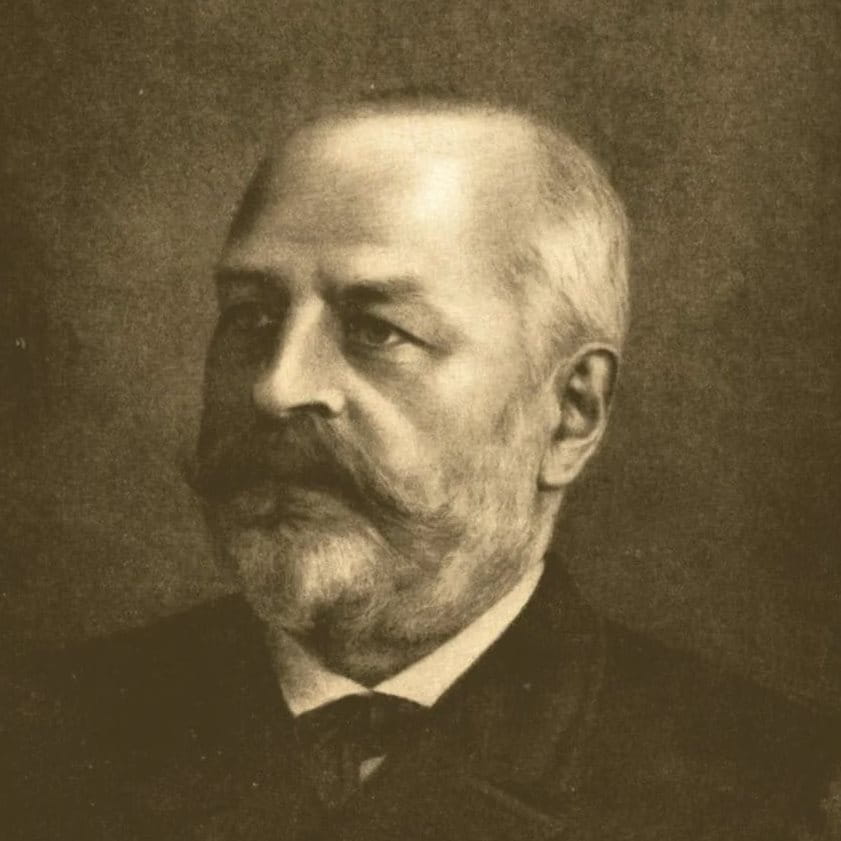
In 1890, pharmacist Dr. Oscar Troplowitz acquired Paul C. Beiersdorf’s laboratory and transformed it into a leading branded goods company. In 1892, he built a new factory in Hamburg-Eimsbüttel, now the company’s headquarters. Under his leadership, brands such as NIVEA and Labello were developed. Troplowitz combined entrepreneurial vision with scientific innovation and an international mindset.
Troplowitz continued the cooperation with Prof. Paul Gerson Unna and recruited the chemist Dr. Isaac Lifschütz at Unna’s recommendation. Lifschütz was the inventor of the emulsifier Eucerit, the basic ingredient and key to the unique properties of NIVEA Creme.
Beiersdorf’s international success began in 1893 with a distribution agreement with the U.S. trading company Lehn & Fink. In 1906, Dr. Otto Hanns Mankiewicz, Oscar Troplowitz’s brother-in-law, joined the company as a partner. He focused on trademark protection and helped shape Beiersdorf’s brand strategy. Beiersdorf has also been a member of today’s German Brands Association since 1905.
Troplowitz and Mankiewicz’s most significant achievement at that time was to create the brands that are so famous today, such as Labello (1909) and NIVEA (1911). Driven by innovation, they created branded goods of consistently reliable quality and real benefit to a broad range of consumers. Troplowitz was convinced that this would be a successful concept for the future. He saw great opportunities for cosmetic care products in particular. This work laid the foundations for the Company’s strategic orientation today.
Following the deaths of Dr. Oscar Troplowitz and Dr. Mankiewicz in 1918, the company first of all became a private limited liability company and then on June 1, 1922, a public limited company. This was the start of its steady development into an international enterprise and at the same time of its establishment and expansion as a leading manufacturer of branded products.