
2/12/2026

Small Cap, big Effect: A Milestone with Double Impact

Take a guess: How many of Beiersdorf’s skin care products are packed in a tube-format? Actually, it’s more than 200 products across NIVEA, Eucerin, Hansaplast and other local brands, such as Florena.

Tubes are liked by consumers for their convenient handling and producers appreciate them for their versatile use. Also, for us at Beiersdorf, it’s an important packaging option for a variety products: not only face care and cleansing products, hand creams and body lotions are packed in a tube format, also some of our shower gels, as well as hair treatment and styling products. But are tubes also state-of-the-art in terms of sustainability and cost? Beiersdorf’s tubes are about to be! Find out about it in this Blog Story.
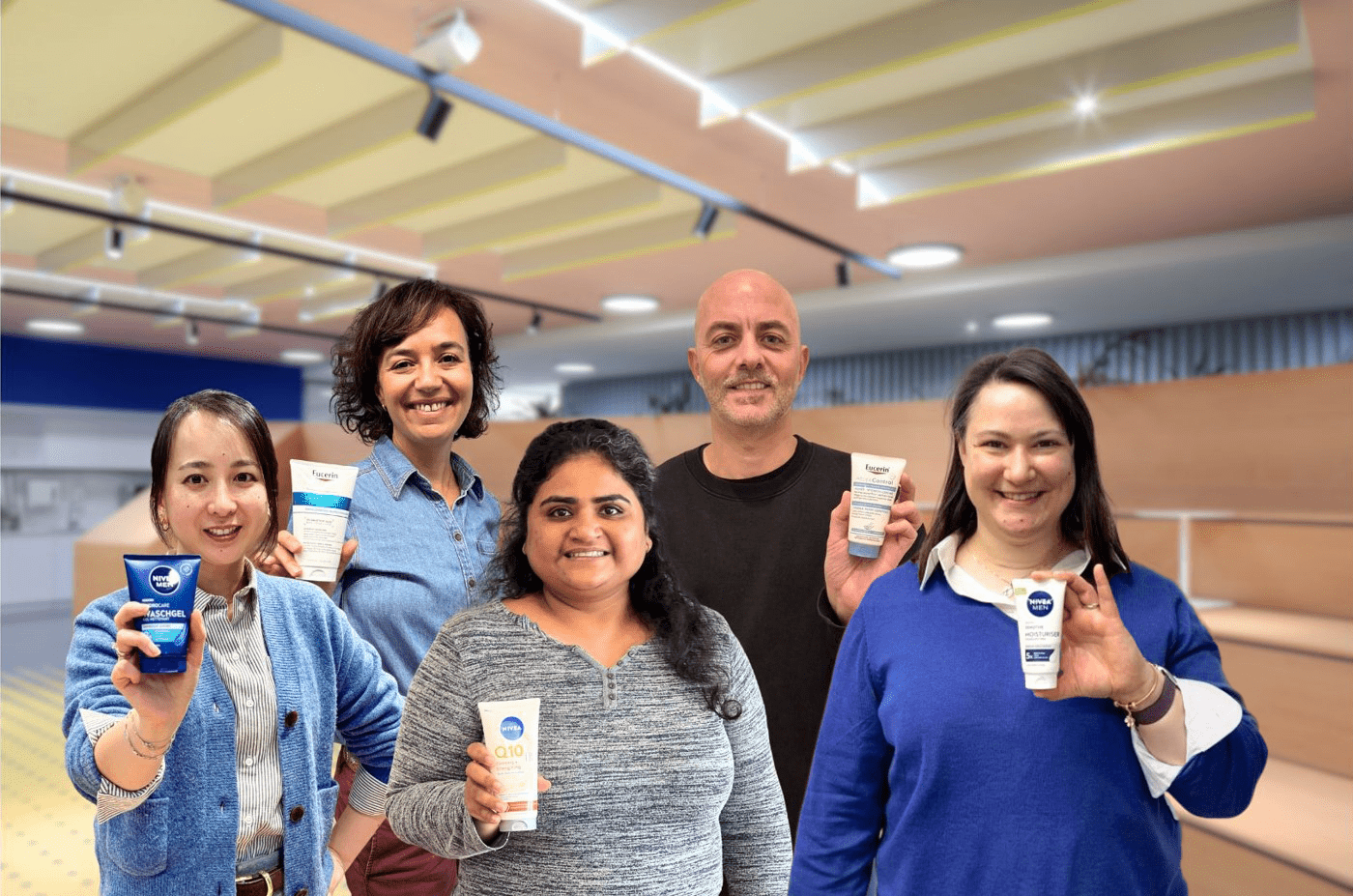
From left to right: Joyce Lindner, Yen Fujii, Cyril Mace, Bhawna Miglani, Maximiliane Sammet

Joyce, you were the leader of this project team. What was the target you aimed for?

Actually, we had several targets to achieve with this project. First of all, to develop a cap – together with our suppliers – that could be used across the different tube sizes and formats of our brand portfolio. So, the target was to create synergies and leverage cost efficiencies across brands. 

Second, we wanted to reduce the material and embed recycled plastic to lower emissions, hence our environmental footprint. 

As we are transforming step by step all our assortments at Beiersdorf towards sustainability, we wanted to make sure that we contribute as best as possible with our project. Our CARE BEYOND SKIN Sustainability Agenda sets ambitious emission-reduction targets and we want to reach Net Zero by 2045. That’s still a long way to go, but every project counts. 

Bhawna, as a Packaging Expert, what were the biggest challenges you had to overcome?

Changing a cap might sound simple at first – but the reality was far from it. What seemed like a small tweak turned into a journey filled with challenges. In fact, it took us three years from start to finish, which speaks volumes about the complexity involved. One major hurdle was capturing the full scope of the project across all our brands and product formats – a task that demanded significant effort. 

Another challenge was to identify the best possible cap design and the right supplier – one that could meet all our requirements without a compromise. Today, seeing the positive impact of this change across so many products is incredibly rewarding. It’s proof that even the smallest details can make a big difference.

Yen, as the responsible project member from NIVEA’s global marketing – what are you most proud of when you look back at this project?

There are two aspects that I am very proud of: First, from a sustainability angle, we realized an impressive impact: We managed to reduce the amount of plastic used to produce the caps by about 640 tons per year. 500 tons of virgin plastic are avoided using recycled material (PCR). Both aspects result in an emission-reduction of more than 4,000 tons of CO2e per year.

Second, also from a marketing perspective, I am very happy and proud that for all representative brands and categories we tested with consumers, we achieved equally good results vs. our old caps and in some cases the new one was liked even better. The new cap design is perceived as more contemporary and modern.

Maximiliane, what did you do to achieve maximum cost efficiency and complexity reduction in the Supply Chain?

From a value engineering perspective, we reduced the number of caps from more than 20 versions that co-existed with our various products to just two cap sizes. And, with regards to color-variation, we reduced the scope from more than 60 colors to only 14 colors across our different brands. We also established this new standard in 8 of our production centers around the world – making this a truly global initiative. So, we pruned our assortment and streamlined the procurement and production process.

Overall, this project is a great example of how sustainability and value engineering can go hand-in hand – creating both an environmental benefit and a cost saving at the same time.

Cyril, producing the caps with less material and recycled plastic – doesn’t that lower the quality?

This was exactly the challenge we were facing from a quality side: to ensure our high quality standard remains – in terms of consumer applicability, in terms of processability and in terms of brand image. It wouldn’t help to have a more sustainable cap that consumers find difficult to open and close, that is not stable during filling and transport, or that doesn’t match our brand requirements in terms of visual appearance.

Also, implementing the new cap for more than 200 products involved a tremendous amount of testing. Here, we took a lean approach: in the beginning of the project, we screened the tube portfolio across all brands to validate the most critical products to these parameters. With this, we had the quality needs defined and could brief our partners on common requirements. 

Joyce, with this great achievement you delivered for Beiersdorf’s sustainability journey, what’s coming next?

Well, there are always several projects that I am working on as a project leader. So, even though, this project is implemented, I am still involved to steer other innovation and transformational projects. Besides us here in our headquarter, sustainability initiatives also take place in our affiliates around the world and at our production centers. Many teams within Beiersdorf are dedicatedly working on delivering towards our Net Zero ambition.


Thanks, dear project team to share about your dedicated work and this great “double impact” you delivered: increased sustainability and costs savings.

About the editor: Katrin J. Selzer

A woman smiling


Katrin has been with Beiersdorf since 2003. After various roles in marketing, strategy, digital and brands PR, Katrin is a Senior Communication Manager since 2018, taking care of sustainability-related stories. She’s very passionate about this topic and enjoys to spread the word and stimulate change through communications.